Human Rights as Social Construction by Benjamin Gregg
Author:Benjamin Gregg
Language: eng
Format: mobi, pdf
Tags: Human Rights, Jurisprudence, Civil Rights, History & Theory, Political Science, Law
ISBN: 9781139505413
Publisher: Cambridge University Press
Published: 2012-08-14T18:30:00+00:00
Cambridge Books Online
http://ebooks.cambridge.org/
Human Rights as Social Construction
Benjamin Gregg
Book DOI: http://dx.doi.org/10.1017/CBO9781139059626
Online ISBN: 9781139059626
Hardback ISBN: 9781107015937
Chapter
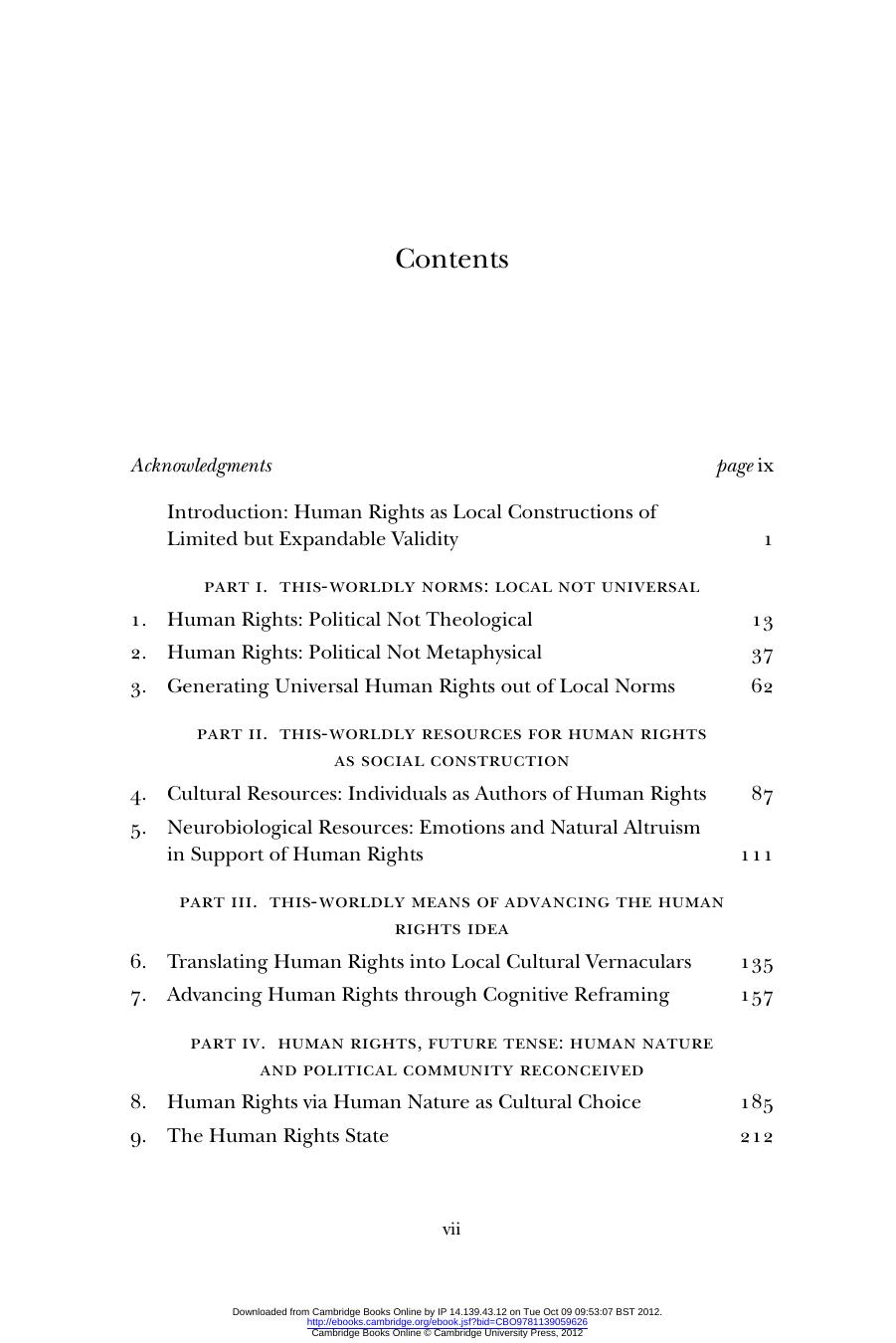
6 - Translating Human Rights into Local Cultural Vernaculars pp. 135-1
56
Chapter DOI: http://dx.doi.org/10.1017/CBO9781139059626.010
Cambridge University Press
6
Translating Human Rights into Local
Cultural Vernaculars
Part III now introduces two particular means of advancing the human
rights idea conceived as social construction. Chapter 6 argues for human
rights work of outside intermediaries and local participants, translating
between local understandings and nonlocal human rights ideas in ways
that preserve local “authenticity” and “legitimacy” – ways that resonate
with local culture even as they also challenge it. Chapter 7 shows how a
cognitive approach allows for human rights as rights internal to any given
community’s culture. It proposes human rights as a learning process that
“cognitively reframes” local cultural and political elements in ways that
render them more human rights friendly.
Both chapters develop something of a sociological standpoint. From
that standpoint, as distinct from a theological one, world religions
show themselves to be dynamic repertoires rather than fixed templates.
Changes in aspects of religious belief have often entailed certain changes
in political organization and commitment. How might religion’s dynamic
potential relate to the surrounding community’s capacity for internal
change? Specifically, would the spread of human rights in some cases
depend on changes in the repertoires of some religions? Consider Islam,
a faith of enduring geopolitical moment. From a sociological perspective
focused on cultural changes that are human rights friendly, how might
the following goal be pursued: a political context in which all ordinary
Muslims enjoyed a culturally recognized, legally protected right to inter-
pret Islam – to interpret with respect to its meanings and to the behavior
that Islam promotes? In what kind of political context might ordinary
Muslims ask themselves not “What is Islam?” but rather “Which Islam do
we Muslims want?”
Perhaps few Muslims would find the idea of multiple “Islams” coherent.
This is likely the case even as more than a few might be willing to entertain
135
Downloaded from Cambridge Books Online by IP 14.139.43.12 on Tue Oct 09 09:53:57 BST 2012.
http://dx.doi.org/10.1017/CBO9781139059626.010
Cambridge Books Online © Cambridge University Press, 2012
136
Human Rights as Social Construction
the possibility of multiple interpretations of what they take to be the uni-
fied singularity of Islam.1 Islam’s spread since the seventh century from
Mecca and Medina across cultures as diverse as those of Morocco and
Indonesia generated multiple, even coexisting Islams. Given the cultural
particularism and peculiar political sensitivities of each host culture,2
multiple interpretations can be expected. But an outside observer’s per-
spective is not likely to be that of the ordinary individual participant in
a particular locale. That is, probably few Muslims would choose among
competing interpretations in terms of what they want, as if their faith
were a matter merely of personal preference or private interest. Perhaps
most would choose in terms of what they take to be the one legitimate or
true understanding of their faith in their particular locale. Abbas Amanat
and Frank Griffel (2007:1) suggest as much: “All normative discussions
within Islam, as well as between Muslims and members of other faiths,
center on the content of Shari’a.” It treats a very wide range of issues,
from acts of worship to marriage, divorce, and inheritance; from taxation
and war to filial piety; from the legitimacy of violence or torture and just
war to means of combating injustice.
Download
Human Rights as Social Construction by Benjamin Gregg.pdf
This site does not store any files on its server. We only index and link to content provided by other sites. Please contact the content providers to delete copyright contents if any and email us, we'll remove relevant links or contents immediately.
The Secret History by Donna Tartt(19028)
The Social Justice Warrior Handbook by Lisa De Pasquale(12182)
Thirteen Reasons Why by Jay Asher(8883)
This Is How You Lose Her by Junot Diaz(6872)
Weapons of Math Destruction by Cathy O'Neil(6261)
Zero to One by Peter Thiel(5782)
Beartown by Fredrik Backman(5734)
The Myth of the Strong Leader by Archie Brown(5491)
The Fire Next Time by James Baldwin(5423)
How Democracies Die by Steven Levitsky & Daniel Ziblatt(5211)
Promise Me, Dad by Joe Biden(5139)
Stone's Rules by Roger Stone(5078)
A Higher Loyalty: Truth, Lies, and Leadership by James Comey(4946)
100 Deadly Skills by Clint Emerson(4911)
Rise and Kill First by Ronen Bergman(4775)
Secrecy World by Jake Bernstein(4738)
The David Icke Guide to the Global Conspiracy (and how to end it) by David Icke(4696)
The Farm by Tom Rob Smith(4500)
The Doomsday Machine by Daniel Ellsberg(4481)
